Have you been feeling tired, unmotivated, distracted, forgetful, or unable to finish everyday tasks? You may wonder whether these symptoms are related to ADD/ADHD or depression.
ADD is an older term that was commonly used to describe attention difficulties without prominent hyperactivity. Today, healthcare professionals generally use the diagnosis ADHD (attention-deficit/hyperactivity disorder), including an inattentive presentation.
ADHD and depression can look similar in some ways, but they are different conditions. ADHD is a neurodevelopmental disorder involving persistent difficulties with attention, organisation, impulsivity and/or hyperactivity. Depression is a mood disorder that can involve persistent low mood, loss of interest, hopelessness, low energy and changes in sleep or appetite. (National Institute of Mental Health)
Understanding the differences can help you know when it is appropriate to speak with a healthcare professional.
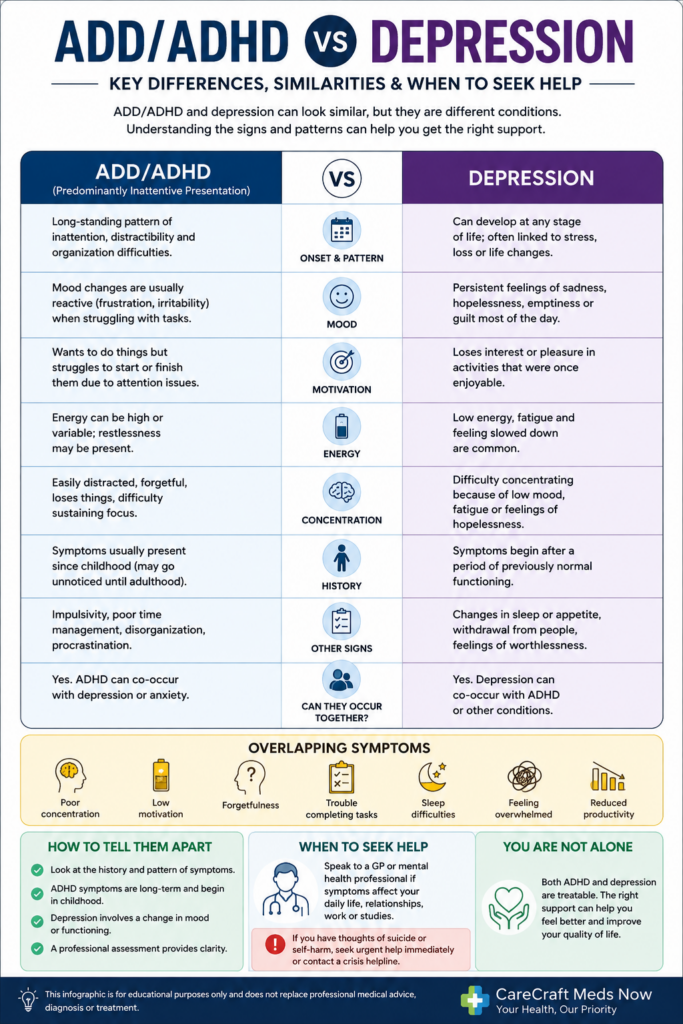
ADD vs Depression: Quick Comparison
| Feature | ADHD/“ADD” | Depression |
|---|---|---|
| Main difficulty | Attention, organisation and impulse control | Persistent low mood and loss of interest |
| Typical pattern | Often long-standing and began in childhood | Can develop at any stage of life |
| Concentration | Frequently distracted or unable to stay organised | Concentration may become difficult because of low mood, fatigue or loss of motivation |
| Motivation | May struggle to start or complete tasks despite wanting to | May lose interest or motivation because activities no longer feel enjoyable |
| Energy | Restlessness or difficulty staying still may occur | Low energy and tiredness are common |
| Mood | Irritability or emotional frustration may occur | Persistent sadness, emptiness, hopelessness or loss of enjoyment may occur |
| Organisation | Forgetfulness, procrastination and poor time management are common | Organisation may decline because of depression-related fatigue or concentration problems |
| Duration | Symptoms are persistent and trace back to childhood | Symptoms may develop later and persist for weeks or longer |
| Can they occur together? | Yes | Yes |
ADHD symptoms generally need to be persistent, occur across more than one setting and cause meaningful difficulties in daily functioning. Depression, meanwhile, is characterised by a persistent change in mood and/or interest accompanied by other emotional, cognitive, physical or social symptoms.
What Is ADD?
ADD is a term many people still use when talking about attention difficulties, particularly when hyperactivity is not obvious.
Modern clinical terminology generally uses ADHD, with an inattentive presentation being one way ADHD can appear.
Someone with predominantly inattentive ADHD may experience:
- Difficulty concentrating
- Forgetfulness
- Losing important items
- Poor organisation
- Procrastination
- Difficulty following instructions
- Problems completing tasks
- Easily becoming distracted
- Poor time management
- Difficulty planning large projects
These difficulties are usually persistent rather than appearing only during a temporary period of low mood. ADHD symptoms typically begin during childhood, although they may not be recognised until adolescence or adulthood.
What Is Depression?
Depression is more than occasionally feeling sad or having a bad day.
It can involve a persistent low mood or loss of interest in activities that a person previously enjoyed. Other symptoms can include:
- Feeling hopeless or helpless
- Low self-esteem
- Persistent sadness
- Loss of motivation
- Feeling unusually tired
- Difficulty concentrating
- Changes in appetite or weight
- Sleeping too much or too little
- Social withdrawal
- Feelings of guilt
- Loss of enjoyment
- Thoughts of suicide or self-harm
Depression can affect work, education, relationships, hobbies and everyday activities.
ADHD vs Depression: What Is the Main Difference?
One of the biggest differences is why the person is struggling.
With ADHD, difficulties with concentration, organisation, time management and impulse control are part of a persistent pattern of symptoms.
With depression, concentration and motivation may decrease because the person is experiencing a depressive episode or persistent low mood.
For example, someone with ADHD may genuinely want to complete an assignment but repeatedly become distracted, forget deadlines or struggle to organise the steps needed to finish it.
Someone experiencing depression may find it difficult to start the assignment because they feel exhausted, hopeless, emotionally numb or unable to enjoy activities they previously cared about.
However, there can be considerable overlap, which is why symptoms alone should not be used to diagnose either condition. Depression, anxiety, sleep problems and other conditions can sometimes produce symptoms that resemble ADHD.
Can ADHD Be Mistaken for Depression?
Yes.
ADHD and depression can share symptoms such as:
- Poor concentration
- Low motivation
- Forgetfulness
- Problems completing tasks
- Irritability
- Sleep difficulties
- Reduced productivity
- Feeling overwhelmed
- Social difficulties
This overlap can make it difficult to determine what is causing the symptoms without looking at the person’s history.
For example, an adult who has struggled with organisation and attention since childhood may have undiagnosed ADHD. On the other hand, someone who previously functioned well but develops concentration problems alongside persistent sadness, fatigue and loss of interest may be experiencing depression.
Healthcare professionals consider the timing, duration, severity and pattern of symptoms when assessing these conditions.
How Can You Tell If It Is ADHD or Depression?
There is no simple online test that can reliably tell you whether you have ADHD or depression.
Instead, consider the overall pattern.
ADHD may be more likely when:
- Attention problems have existed for many years.
- Symptoms can be traced back to childhood.
- You regularly lose things or forget appointments.
- Organisation and time management have consistently been difficult.
- You struggle to complete tasks even when you are interested in them.
- Symptoms occur in multiple areas of life, such as work, home and relationships.
NIMH notes that adult ADHD involves persistent symptoms that interfere with functioning and that symptoms must have been present earlier in life.
Depression may be more likely when:
- Your symptoms developed after a period of previously normal functioning.
- You feel persistently sad, empty or hopeless.
- You have lost interest in activities you previously enjoyed.
- You feel unusually tired or slowed down.
- Your sleep or appetite has changed.
- You withdraw from friends and family.
- You experience significant feelings of guilt or worthlessness.
The NHS advises adults to speak with a GP when depression symptoms occur most of the day, every day, for more than two weeks.
Can You Have ADHD and Depression at the Same Time?
Yes.
Having ADHD does not prevent someone from developing depression.
In fact, ADHD can occur alongside other mental health conditions, including depression and anxiety.
Living with untreated or poorly managed ADHD can sometimes create repeated difficulties at school, work, relationships or everyday life. These challenges can contribute to emotional distress, although they do not mean that everyone with ADHD will develop depression.
If someone has symptoms of both conditions, a healthcare professional can assess each condition separately and determine what support may be appropriate.
ADHD and Depression in Adults
The difference can sometimes be particularly difficult to recognise in adults.
Adult ADHD may appear less like obvious hyperactivity and more like:
- Constant procrastination
- Forgetting appointments
- Difficulty prioritising
- Poor time management
- Starting projects but not finishing them
- Frequently losing belongings
- Difficulty maintaining routines
- Restlessness
- Being easily distracted
Depression may instead involve a noticeable change from a person’s usual functioning, together with persistent low mood, loss of enjoyment, fatigue or feelings of hopelessness.
Adults can also have both conditions at the same time, making professional assessment particularly important. If you’re experiencing persistent difficulty with concentration, organisation, forgetfulness, or managing everyday responsibilities, learn more about the [common ADHD symptoms in adults] and when it may be helpful to seek professional assessment.
Why Professional Assessment Matters
It can be tempting to search online for an ADHD or depression checklist and decide which condition best matches your symptoms.
However, similar symptoms can occur with several different conditions.
For ADHD assessment, clinicians may look at childhood history, current symptoms, functioning at home and work, medical history and other possible explanations.
For depression, a healthcare professional may ask about mood, symptoms, daily functioning, medical history, previous mental health problems and recent life events.
This is important because treating the wrong underlying problem may delay appropriate support.
When Should You Speak to a Doctor?
Consider speaking with a GP or qualified mental health professional if:
- Concentration problems are affecting your work or education.
- Forgetfulness or disorganisation is interfering with everyday life.
- You have persistent low mood.
- You have lost interest in activities you previously enjoyed.
- Your sleep or appetite has significantly changed.
- Symptoms are affecting your relationships.
- You are unsure whether your symptoms are ADHD, depression or something else.
If you have thoughts of suicide or self-harm, seek urgent professional help rather than trying to diagnose yourself online. The NHS specifically recommends seeking help when depression involves suicidal or self-harm thoughts.
Frequently Asked Questions About ADD vs Depression
Is ADD the same as depression?
No. ADD is an older term associated with attention difficulties and is now generally covered under the ADHD diagnosis. Depression is a mood disorder characterised by symptoms such as persistent low mood and loss of interest.
Can depression look like ADHD?
Yes. Depression can cause concentration difficulties, low motivation, fatigue and problems completing everyday tasks. These symptoms can resemble ADHD, which is why professional assessment is important.
Can ADHD cause depression?
ADHD itself is not the same condition as depression, but people with ADHD can also experience depression. The NHS and NIMH both recognise depression as a condition that can occur alongside ADHD.
How do I know if I have ADHD or depression?
Look at the history and pattern of your symptoms rather than one symptom alone. ADHD symptoms generally represent a persistent pattern that began earlier in life, while depression commonly involves a period of persistent low mood, loss of interest and associated symptoms. A healthcare professional can assess the difference.
Can you have ADHD and depression together?
Yes. Having both conditions is possible. A clinician can assess symptoms of each condition and help determine appropriate treatment and support.
Does ADHD cause low motivation?
People with ADHD can have difficulty starting, organising and completing tasks. However, low motivation can also occur with depression, so motivation problems alone cannot determine whether someone has ADHD.
Can depression cause forgetfulness?
Yes. Depression can affect concentration and thinking, which may make someone feel forgetful or mentally slowed down. This is one reason depression can sometimes be confused with ADHD.
Is ADHD or depression more serious?
Neither should be dismissed. Both can significantly affect daily life, relationships, education and work. The appropriate response depends on the person’s symptoms, severity and circumstances.
Final Thoughts: ADD vs Depression
ADD/ADHD and depression are different conditions, but they can look surprisingly similar.
ADHD is primarily associated with a persistent pattern of attention, organisation, impulsivity and/or hyperactivity difficulties, while depression involves persistent changes in mood, interest, energy and other emotional or physical symptoms.
The most useful clue is often the timeline: ADHD symptoms generally have roots in childhood, whereas depression may represent a significant change from a person’s previous level of functioning. However, both conditions can occur together.
If concentration, motivation, mood or daily functioning has become difficult to manage, speaking with a qualified healthcare professional can help you understand what is happening and identify appropriate support.